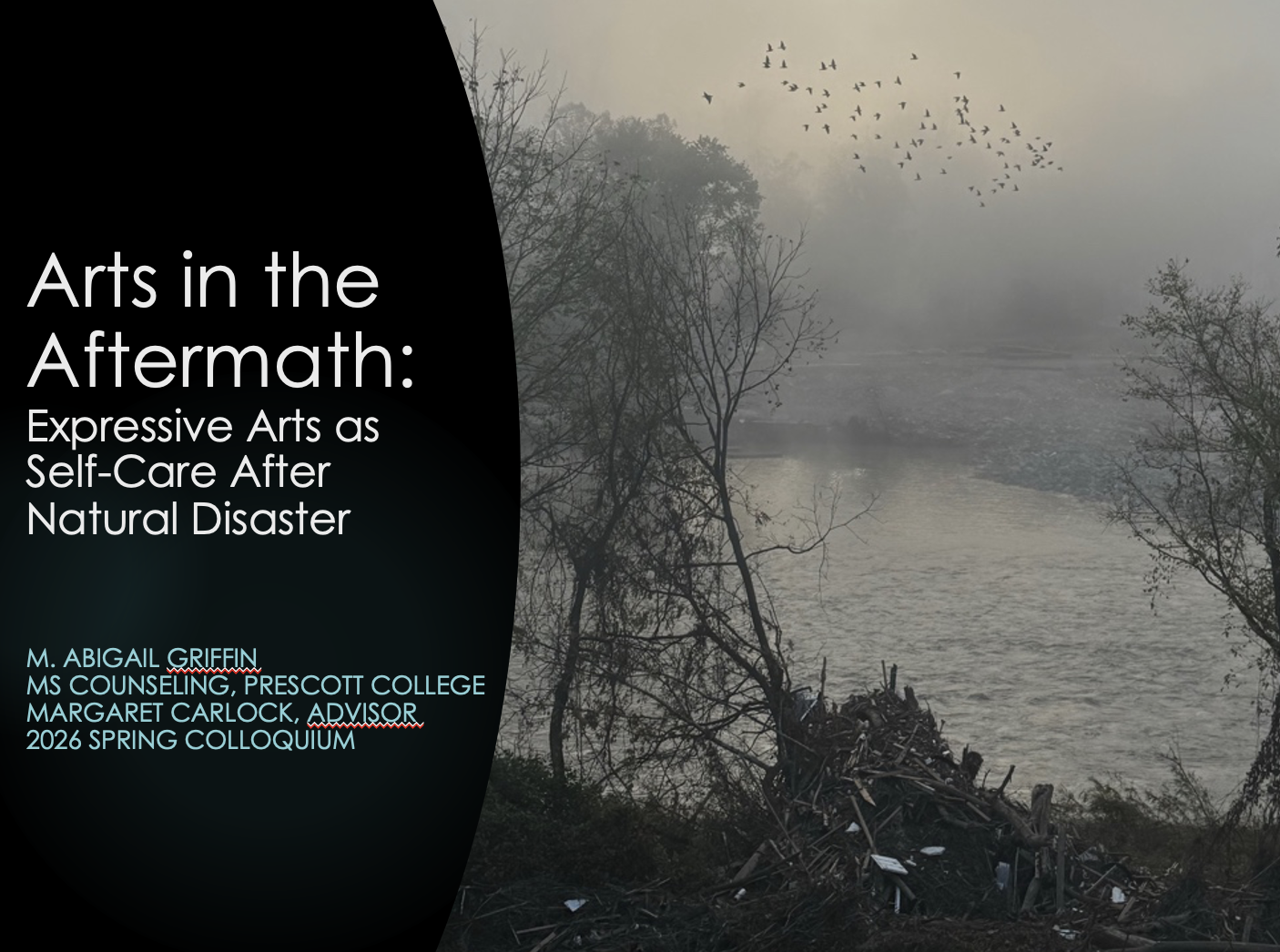
Expressive Arts as Self-Care After Natural Disaster
Arts in the Aftermath: Expressive Arts as Self-Care After Natural Disaster
In the months following Hurricane Helene, I found myself reaching for creativity in ways that felt instinctive rather than planned. Cooking. Strumming chords. Crafting. Painting. Moving. Writing. Sitting with images. Walking the land. Returning again and again to simple creative acts that helped me orient myself when words fell short.
This research grew out of that lived experience.
I am a graduate student in Expressive Arts Therapy, but this work did not begin as an academic project. It began as a response to disruption, loss, and the deep sense of place-based grief that can arise when the landscape you love is altered. Over time, my personal creative practices began to intertwine with my academic studies, eventually becoming the foundation for my capstone work, Arts in the Aftermath: Expressive Arts as Self-Care After Natural Disaster.
The PDF shared here is a visual companion to that work. It is the slide deck from my presentation, offered as a reflective resource. It does not include spoken explanation. Instead, it holds images, key concepts, prompts, and frameworks that emerged from my inquiry.
Why Expressive Arts
Expressive arts offer something uniquely suited to times of upheaval. They allow us to work across sensation, image, movement, and symbol without requiring clarity, productivity, or resolution. In the aftermath of a disaster, many people feel disconnected from their bodies, their creativity, or their sense of safety. Expressive arts can provide gentle points of re-entry.
This work explores creative practice not as therapy delivered to others, but as self-care. As something we can turn toward ourselves. As a way of listening, metabolizing experience, and slowly rebuilding internal and external landscapes.
What You’ll Find in the PDF
• Context for this inquiry and how the work took shape
• Overview of natural disasters and common mental and emotional impacts
• Introduction to expressive arts therapy and expressive arts as self-care
• Reflections on creative practice in the aftermath of natural disaster
• Images and documentation from my own expressive arts practice
• Conceptual frameworks that informed the work
• Closing reflections and points of integration
A Note on Scope and Intention
This material is shared as reflective, educational, and creative inquiry. It is not therapy, and it is not intended to diagnose, treat, or replace mental health care. I am not a licensed therapist or expressive arts therapist, and nothing here should be understood as clinical guidance or instruction.
The practices and reflections offered are invitations, not prescriptions. Readers are encouraged to engage in ways that feel appropriate for their own capacity, context, and support systems.
With care,
Abigail